
The Real Education Gap Starts Before University
IlmGhar Team · 2 Jul 2026
Pakistan's education debate focuses on universities — but the real gap starts in primary school. A look at the 2026-27 budget, schooling years and ASER learning levels, and what it means for parents.
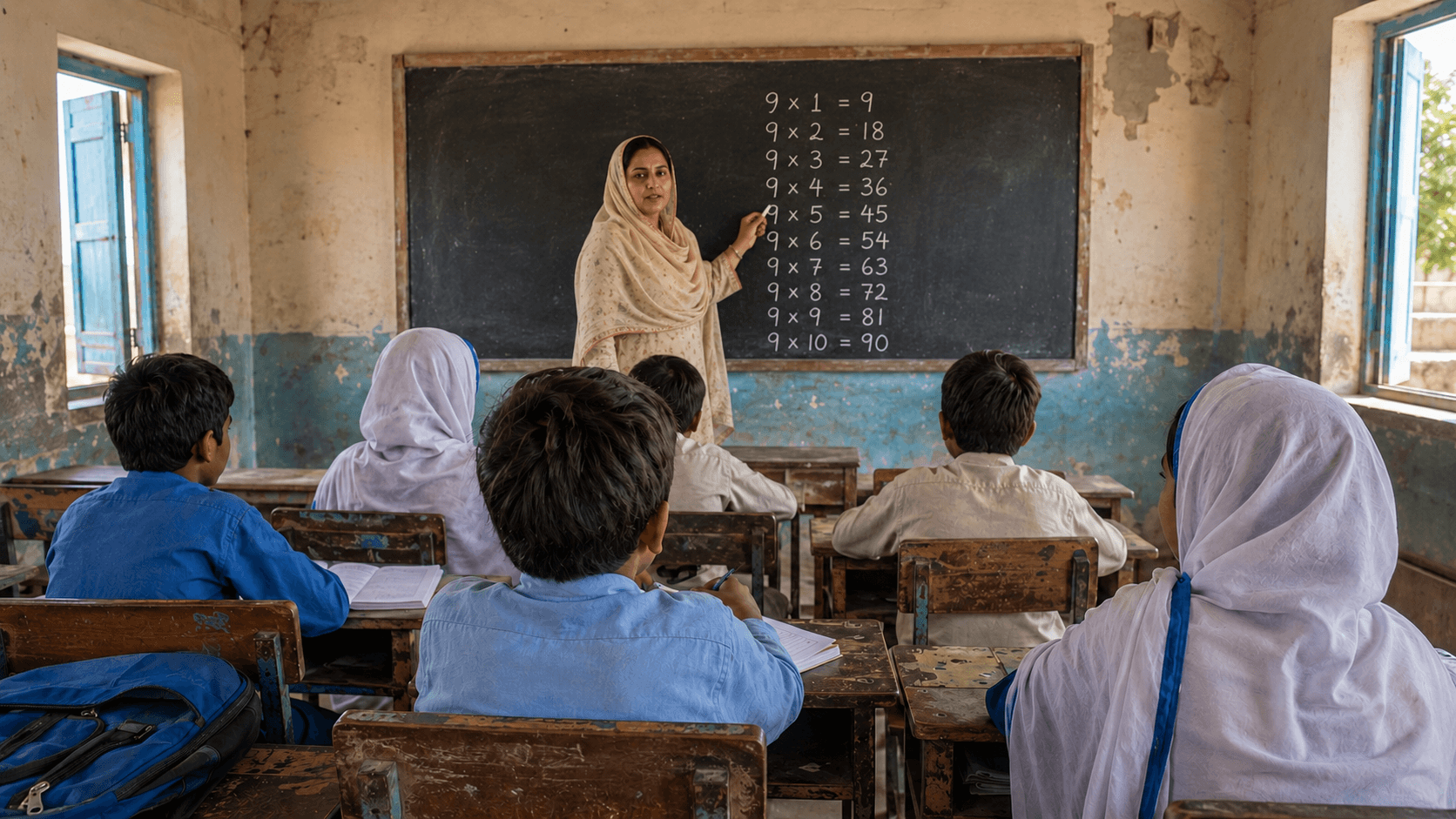
Pakistan talks a lot about universities, degrees, jobs, and skills. Parents want their children to become doctors, engineers, software developers, teachers, business owners, and professionals. The government also talks about higher education because universities are linked with employment, research, innovation, and economic growth.
That is all important.
But there is one uncomfortable truth we often ignore.
The real education gap does not start at university. It starts much earlier.
It starts when a child reaches class 5 but still struggles with class 2 reading. It starts when a student moves into secondary school without strong maths basics. It starts when children are promoted from one class to the next, but their concepts remain weak. By the time that child reaches college or university, the problem is no longer small. It has already been growing quietly for years.
This is why Pakistan's education debate needs to look more seriously at school learning, not only university funding.
How Pakistan spends its education budget
According to the Annual Budget Statement 2026-27, the federal government has budgeted Rs 117.748 billion for current expenditure on education affairs and services. Current expenditure is the money that keeps the existing system running — salaries, pensions, and the day-to-day cost of operating schools, colleges, and universities that already exist. Out of this, Rs 84.462 billion is for tertiary education. Pre-primary and primary education receives Rs 6.275 billion, while secondary education receives Rs 16.015 billion.
Source: Annual Budget Statement 2026-27
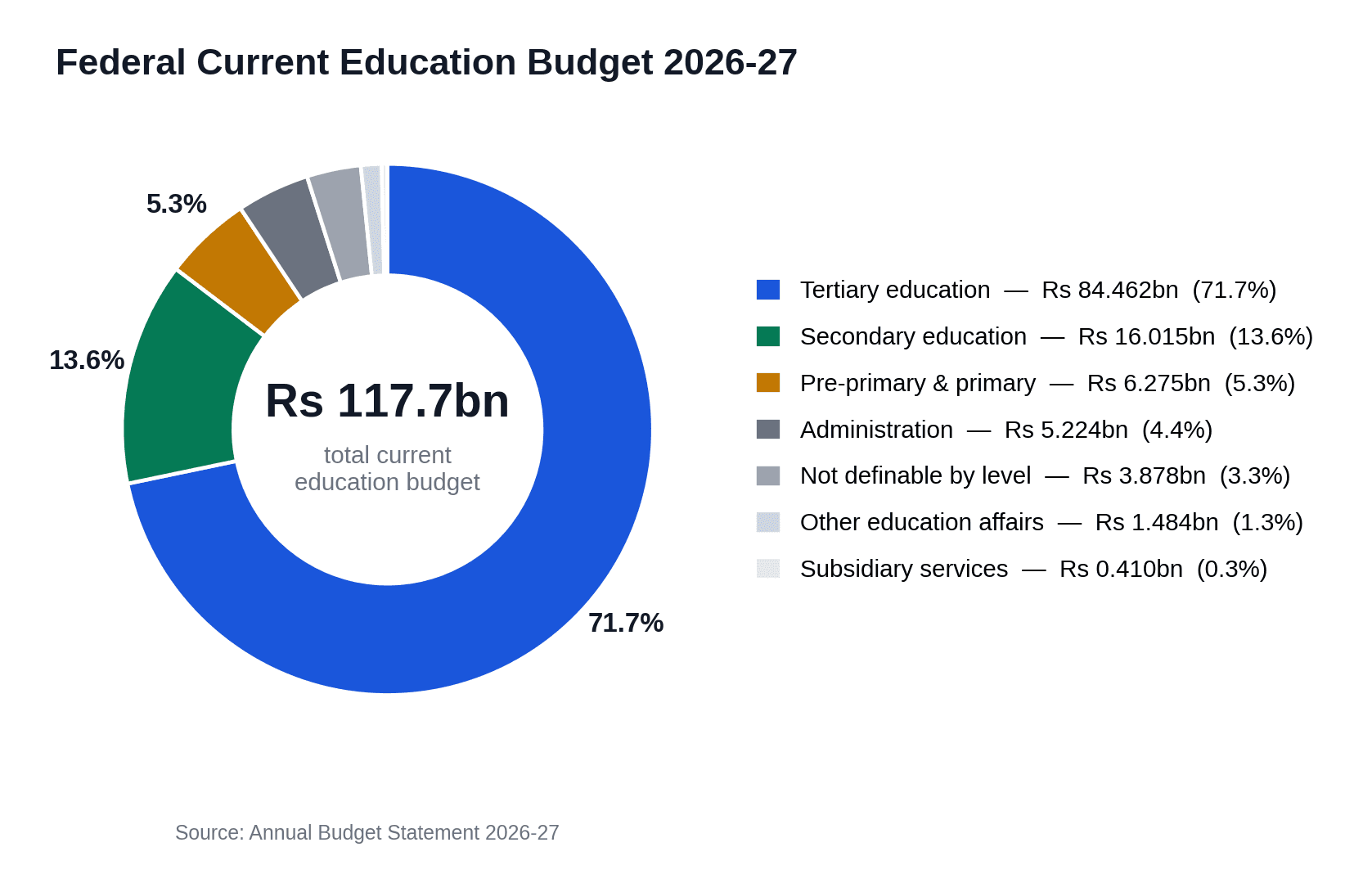
Federal current education budget 2026-27 by area. Source: Annual Budget Statement 2026-27.
This does not mean universities are not important. They are important. Pakistan needs better universities, better research, and better professional training.
But a university cannot fully repair what school failed to build.
A student who cannot read confidently will struggle in every subject. A student who is weak in basic arithmetic will struggle later in algebra, physics, accounting, statistics, and computer science. A student who has spent years memorising without understanding may pass some exams, but will find it difficult to think independently later.
The same pattern appears in federal development spending. Development expenditure is different from current expenditure: instead of running what already exists, it pays to build and expand — new campuses, buildings, laboratories, and equipment. Education development expenditure is budgeted at Rs 76.381 billion for 2026-27. Out of this, Rs 72.059 billion is for tertiary education.
Source: Annual Budget Statement 2026-27
| Education Area | Federal Development Budget 2026-27 |
|---|---|
| Tertiary education | Rs 72.059 billion |
| Subsidiary services to education | Rs 0.722 billion |
| Other education affairs and services | Rs 3.600 billion |
| Total development education spending | Rs 76.381 billion |
There is one important point here. In Pakistan, education is mostly a provincial responsibility, so the federal budget is not the full picture of education spending. Still, these federal numbers tell us something important about national priorities. They also remind us that school foundations deserve more attention in public discussion.
Too few years in school
Pakistan's schooling indicators already show the size of the problem. The Pakistan Economic Survey 2025-26 lists Pakistan's expected years of schooling at 7.9 years and mean years of schooling at only 4.3 years. This is lower than many regional countries. Bangladesh is listed at 12.3 expected years and 6.8 mean years, while India is listed at 13.0 expected years and 6.9 mean years.
Source: Pakistan Economic Survey 2025-26
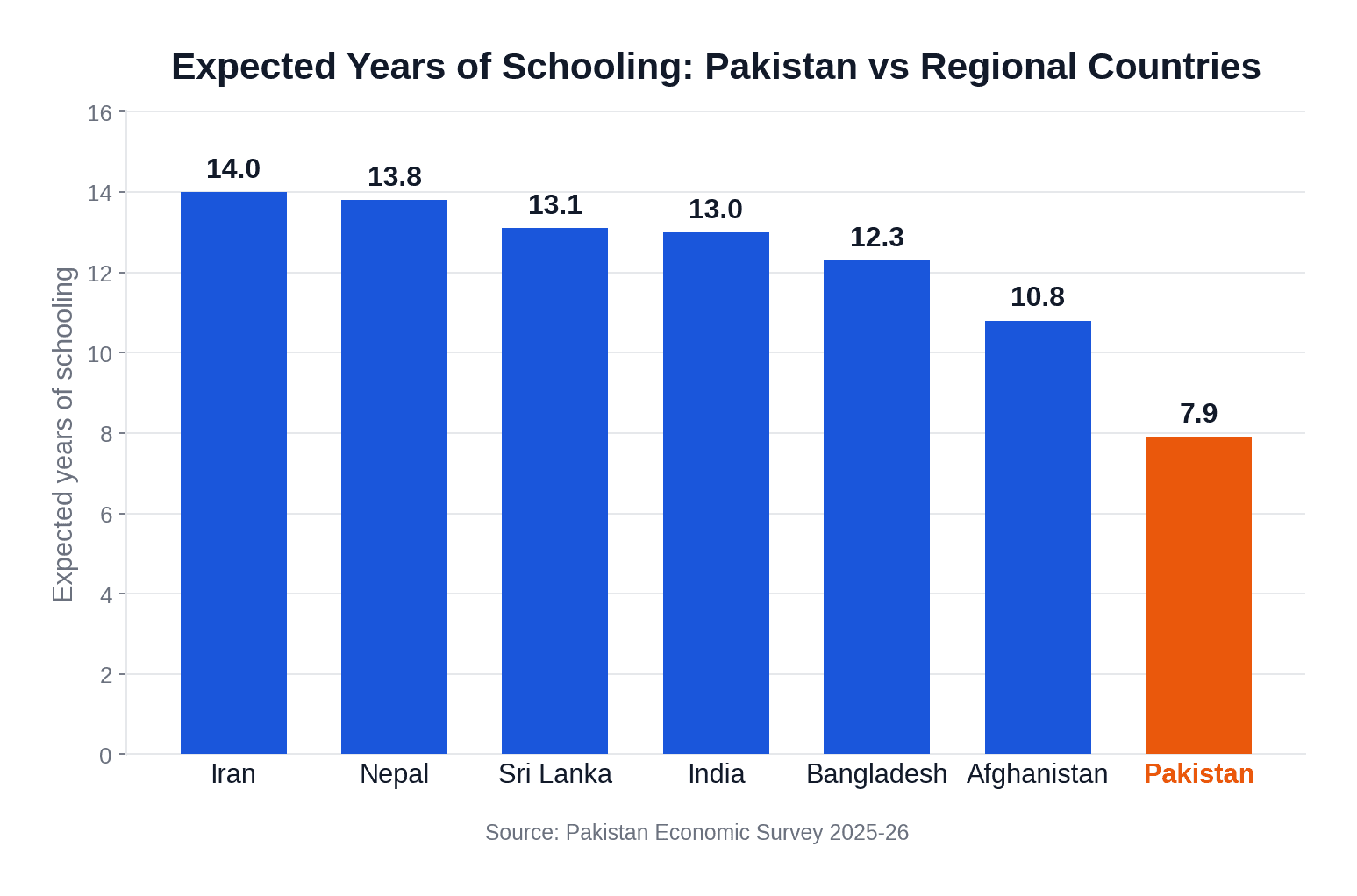
Expected years of schooling: Pakistan vs regional countries. Source: Pakistan Economic Survey 2025-26.
These numbers show that Pakistan's issue is not only about producing more university graduates. The issue is also about how long children stay in education and how much they actually learn during those years.
A weak school foundation creates a chain reaction.
A child who struggles with reading in primary school may struggle with science, social studies, Islamiat, Pakistan Studies, and even maths word problems later. A child who does not understand basic maths may start fearing maths in middle school. A student who memorises without understanding may pass some tests, but lose confidence when concepts become harder.
This is how the education gap grows quietly.
Millions of children are still out of school
Pakistan also faces a major access problem. UNICEF reports that Pakistan has the world's second-highest number of out-of-school children, with around 25.1 million children aged 5 to 16 not attending school. That is about 35% of children in this age group.
Source: UNICEF Pakistan Education (unicef.org/pakistan/education)
| Area | Out-of-School Children |
|---|---|
| Punjab | 9.7 million |
| Sindh | 7.4 million |
| Khyber Pakhtunkhwa | 4.5 million |
| Balochistan | 3.5 million |
| Islamabad Capital Territory | 0.09 million |
| Pakistan total | 25.1 million |
This is the first part of the education gap: many children are not in school at all.
But the second part is just as important.
In school, but still not learning
Many children who are in school are still not learning at the expected level.
A child can attend school every day and still fall behind. The notebook may be complete. The homework may be copied. The test may be attempted. But the concept may still be weak.
The ASER Pakistan National 2025 report shows this clearly. Only 52.3% of class 5 children could read a class 2 level story in Urdu/Sindhi. Only 56.3% of class 5 children could read class 2 level English sentences. In maths, only 49.6% of class 5 children could do two-digit division.
Source: ASER Pakistan National 2025
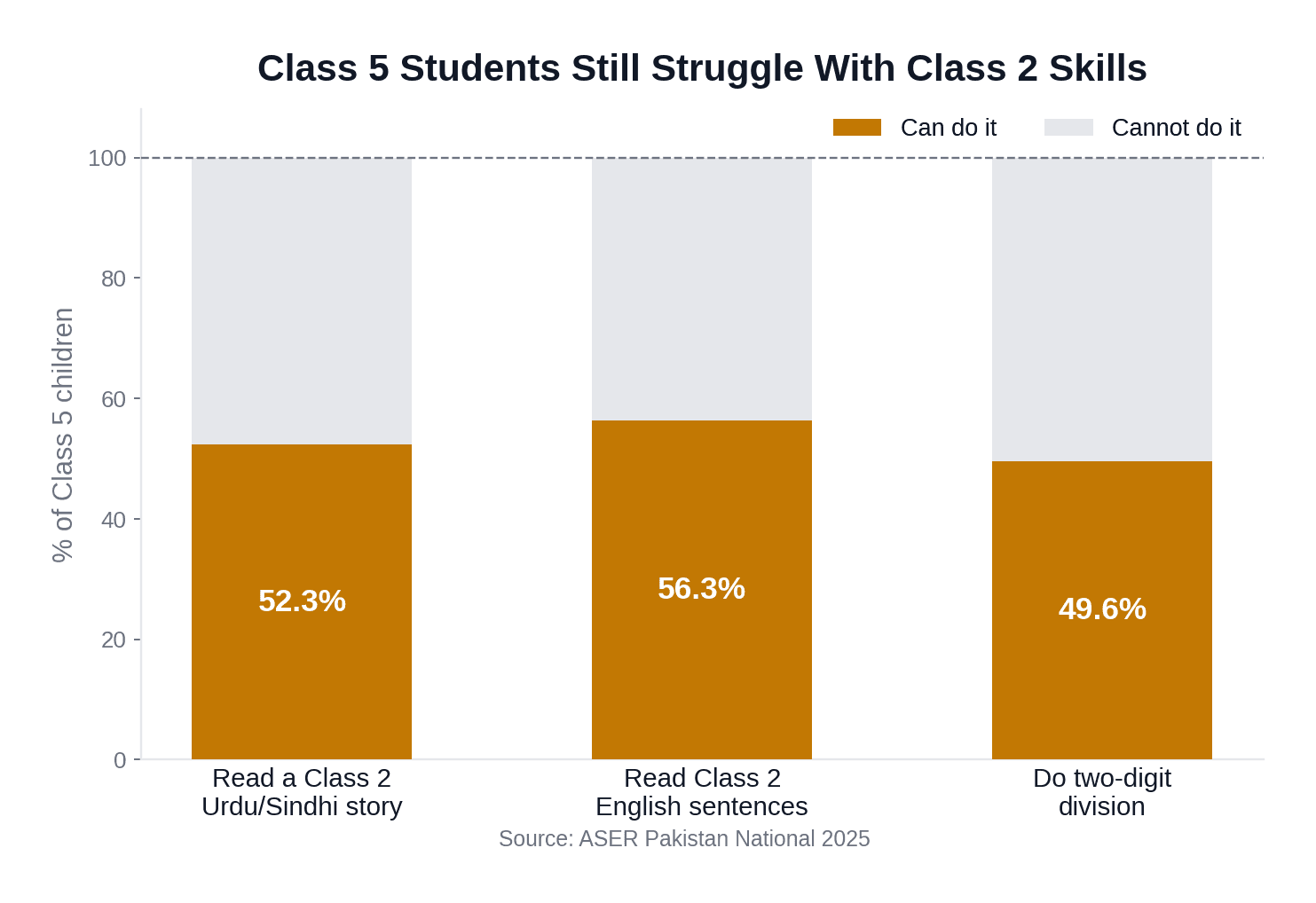
Class 5 students measured on class 2 level skills. Source: ASER Pakistan National 2025.
This is where the real issue becomes obvious.
If almost half of class 5 children cannot perform class 2 level tasks, then the problem is not just about board exams, university admissions, or job skills. The problem starts at the foundation.
And when the foundation is weak, everything built above it becomes harder.
A child weak in reading will struggle with science questions. A child weak in English will struggle with instructions, comprehension, and written answers. A child weak in maths will panic when the syllabus moves to fractions, algebra, geometry, or word problems.
Slowly, the child starts believing, "I am weak in studies."
Many times, the child is not weak. The foundation is weak.
Why so many parents turn to tuition
This is also one reason tuition has become so common in Pakistan.
Parents are not always looking for something fancy. Many are simply worried. They see that their child is attending school, but still does not understand the lesson properly. They see weak marks, poor confidence, exam fear, and daily homework stress. So they look for extra help.
ASER 2025 reports that 49.2% of private school students and 24.4% of government school students were attending paid tuition.
Source: ASER Pakistan National 2025
| School Type | Students Attending Paid Tuition |
|---|---|
| Private school students | 49.2% |
| Government school students | 24.4% |
This shows that tuition is not just a luxury. For many families, it has become a response to a real learning need.
Parents already pay in many ways. They pay school fees, books, uniforms, transport, stationery, exam fees, and often tuition as well. In a way, many parents are paying twice: once for schooling, and again for learning support.
That is why the real question is not only:
How much money is being spent on education?
The better question is:
Are children actually learning at the right time?
If a child is weak in class 3, help should come in class 3. Not after years of struggle. If a child cannot read properly in primary school, support should come before secondary school. If a child is scared of maths, the solution is not more pressure. The solution is clearer teaching, patience, practice, and personal attention.
Where IlmGhar fits in
This is where platforms like IlmGhar matter.
IlmGhar is not a replacement for schools. Schools are essential. But many students need extra support outside school, and parents need a safer, more reliable way to find that support. A good tutor can identify weak areas, explain concepts in a simpler way, help with revision, prepare the child for tests, and rebuild confidence.
The need is already there. The question is whether families can find tutors with trust, verification, and proper protection.
Pakistan's future does not depend only on producing more university graduates. It depends on whether children can read, understand, calculate, ask questions, and think clearly before they ever reach university.
The real education gap starts before university.
And if we want stronger graduates tomorrow, we have to build stronger school learners today.
Looking for a verified tutor?
Browse admin-verified home tutors anywhere in Pakistan and hire with confidence.